
|
|
 |
|
|
|
|
|
|
|
|
|
|
|
|
|
|
|
 |
 |
 |
 |
 |
 |
||||||||||
 |
|||||||||||||||
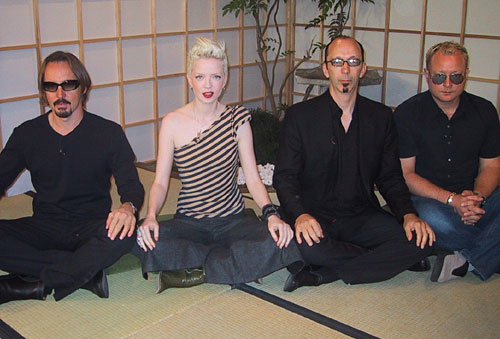
| From Left: Butch Vig, Drums/Sound Effects Shirley Manson Vocals/Guitars/Lyrics Duke Erikson, Guitars Steve Marker, Bass |
|||||||||||||||
| What Is This Garbage? beautifulgarbage. It’s a phrase that suggests ruin and glamour in equal measure: glad rags corseting a broken heart, or mascara running in public. It’s also the title of the third album from Garbage – thirteen songs written because it would’ve hurt not to. This is the band’s most extreme record to date, more melodic and emotional, dirtier and clearer. If it’s pop, then it’s pop for non-prom queens, dance music for the dysfunctional. “On beautifulgarbage I think we were more conscious of trying to keep things more straightforward and simple,” says Butch Vig. “A lot of it is in the lyrics, and they’re the best that Shirley’s written. Some of them are very direct, the melodies are really strong and we shied away from, ‘Let’s see how far we can sonically go off with this’.” “The earlier stuff we did, a lot of it was a lot more abstract in every sense, sound wise and lyric wise,” adds Steve Marker. “I think it was easier to find a direction for each of these songs because the words were more open about what they’re trying to say.” Garbage are mutating. Songs like ‘Shut Your Mouth’, ‘Androgyny’ and ‘Untouchable’ mate the bold strokes of pop and hip-hop with abrasive rhythm guitar and eerie treatments. By contrast, the beautiful bruises of torch songs like ‘Can’t Cry These Tears Anymore’ and ‘Drive You Home’ beg to be tended to by The Crystals or Julee Cruise, while ‘Cherry Lips’ is strychnine-flavoured bubblegum. “I think we felt more comfortable in going to both extremes on this record,” says Duke Erikson. “There are songs that are much more playful on this record than anything on records one and two, and there are tracks that are much heavier and darker, both lyrically and musically. In some ways this record may sound like a sharp departure from the first two, but think we really only expanded the turf we'd established for ourselves and used a simpler, more stark approach in doing so.” In its broad span of sounds and styles, beautifulgarbage evokes everything from Prince to The Stones, Parallel Lines-era Blondie to Phil Spector. But it’s also characterised by an aching, not least on the twilit ‘Nobody Loves You’, ‘Cup Of Coffee’ or the closing ‘So Like A Rose’, which suggests John Carpenter directing his namesake Karen. “It was the time of night,” says Shirley Manson of the latter song. “When I started singing, I just had the first line, and it reminded me of a boy who was in my peer group when I was a teenager. It sort of transported me into that time of my life and it reminded me of sitting in my bedroom listening to records and them touching me when I felt like an alien. It’s about departure of sorts, the desire to flee, the desire to transform and the desire to escape.” Garbage convened to work on the new album in April 2000 after the four-month break that followed the mammoth Version 2.0 campaign. The sessions frequently involved periods of wool gathering followed by frantic bursts of spontaneous composition. Call it a rock ‘n’ roll version of Zen painting, if you will. For Shirley, it was time to say it all or nothing. “I’ve been away from home for a long, long time, and going into this record, I felt, ‘This has got to mean something to me to make it worthwhile sacrificing the time spent away from people that I love’. And so I wanted to say what I wanted to say, otherwise I wasn’t interested in doing it. This was all a subconscious decision in a way, so by the time I came here (to Smart Studios), I had lots of ideas already in my head. And when I got together with the boys and we started playing together, I was able to come up with stuff on the spot much easier and much more comfortably than I had in the past, which I had found agonising to do. We were at such a comfortable point with each other, I was able to do that.” Garbage: the shiny black skin of a PVC sack holding in all manner of rotting matter and psychic creepy-crawlery. When the band’s eponymous debut album was released on Mushroom in 1995, it touched on a whole cluster of nerves. The prevailing climate was one of moral panic, a Millencholia reflected by films like Se7en and Natural Born Killers. Pop culture was a paranoiac mess whose poster girl might have been Laura Palmer turning blue in the water. To paraphrase Lou Reed, you couldn’t even trust your mother. In the midst of this, Garbage’s groundbreaking clips for songs like ‘Stupid Girl’ and ‘Only Happy When It Rains’ suggested three covert government operatives keeping tabs on a red-haired geisha, while the songs sounded like JG Ballard’s worst neuroses transposed into a kind of deviant glamour pop. ‘Supervixen’, ‘Queer’ and ‘Vow’ were at once eroticised, angry and industrial, with barbed hooks that found easy purchase in the soft meat of the brain. Most great music has a sense of location, a source, be it mythic or geographic. Despite Shirley’s strong Scottish roots, Garbage are synonymous with Madison, Wisconsin, a place that, they’ll waste no time reminding you, is often referred to as the serial killer capital of the world. “I think there’s a sense of alienation about the mid-west in relation to the coasts, the same way that for a long time the Scots felt an alienation,” Shirley points out. “This sense of isolation has actually been a motivating force for us as people, in our lives, not just in a band. I think we’re quite happy being on the outskirts, we’re accustomed to that, almost as observers rather than participators.” The impressionable blow-in might describe Madison – a campus town located between Lake Mendota and Lake Monona – as Fargo in winter, Blue Velvet in spring. Take a walk down East Washington Avenue, past the Pontiac workshops and car dealerships and gas stations, and you’ll come to a squat redbrick building with grey doors. The place looks as if it has been shunned by its kind – there’s a 20 ft gap between the building and its closest neighbour, and a nearby barbershop seems to have shuffled across the road in order to maintain a healthy distance. Looking at this anonymous structure, a line from ‘Love Street’ comes to mind: “I wonder what they do in there?” The yellow of the traffic lights, the fire engine red of the hydrant and the lurid green of the nettles suggest shades of Lynchville. Peer beneath a brown bench chained to a wall and you’ll find a small blob of amorphous matter about the size and shape of a human ear. It is swarming with angry red ants. The David Lynch references are not just for colour – the director once visited here with his son, a beautiful boy with Eraserhead hair. This is Smart Studios, where all the Garbage albums were born. Before Garbage, Duke Erikson, Steve Marker and Butch Vig had all been playing together for years in Wisconsin bands like Firetown and Spooner, and the latter pair founded Smart in 1984. Future clients would include Depeche Mode, Nine Inch Nails and U2, and Vig came to establish himself as one of the defining producers of the 90s through his work for Nirvana, the Smashing Pumpkins and Sonic Youth. Shirley Manson came from Edinburgh via bands like Goodbye Mr MacKenzie and Angelfish, the daughter of a singer and a geneticist. Their debut album went on to sell more than four million copies worldwide, garnering three Grammy nominations and making fans of people like Chrissie Hynde and Françoise Hardy. Sustained touring transformed the foursome from a studio entity into a pretty powerful live outfit, while Shirley became a familiar fixture on the covers of style magazines and rock comics alike. Three years later, in the spring of 1998, Version 2.0 was born into a world of hurt and uncertainty in rock ‘n’ roll. Second album bands were dropping like flies and even major league acts like U2 and REM seemed to founder. Version 2.0 was a slow starter, but a string of hit singles (including ‘I Think I’m Paranoid’, ‘Special’ and ‘When I Grow Up’), plus a relentless 20-month touring campaign across four continents pushed it from the red into the black. By 1999, Version 2.0 had almost equalled the sales of its predecessor and scored yet more Grammy nominations, although those were possibly the least interesting aspects of the record. With their claustrophobic meshes of flesh and technology, songs like ‘Push It’ and ‘Temptation Waits’ called to mind the unfortunate protagonist of Shinya Tsukamoto’s film Tetsuo, who has a close encounter with a fetishist and wakes up the next morning to find metal scabs growing from his skin. Externally, the record was all shiny chrome surfaces, but you didn’t have to probe too deep to find a mess of nerves, a kind of prosthetic soul music. Shirley: “I think that when Version 2.0 came out, because it was our second album and we didn’t have that initial thrill/thrust of a debut, nobody thought we’d be able to recreate the success of the first record. Not everyone was as ra-ra as they had been on the first album for us and we really knuckled down and toured our asses off and sort of found in ourselves this self-perpetuating mechanism that propelled the success of the record. I think that sort of independence in a way really helped our inner chemistry when we came back in and started writing.” In the autumn of 1999 Garbage got a taste of mainstream film industry mechanisations when they were invited to co-write the title song to the James Bond flick The World Is Not Enough with David Arnold. Shirley: “He actually was a joy, it was working with the movie company was mildly problematic because musicians pretty much march to their own drum, and all of a sudden you’ve got a huge powerful movie company trying to have creative control over basically a wild beast and it caused some conflicts.” “We’re control freaks basically,” adds Butch. “You realise just as soon as you start working with a big film company and an institution like James Bond, you’re stepping into a different planet, and it was pretty eye-opening and exciting and crazy and problematic and fucked up; you’re in a different world so to speak.” In a way, the tone of candour that runs through beautifulgarbage was pre-ordained by a photo shoot Shirley Manson did for Calvin Klein prior to recording. Shirley: “It’s funny, that whole experience was really remarkable and I actually wrote a letter to Calvin Klein telling him that he basically did something incredible for me. He asked me very early on if I’d be willing to model for him, and I was kind of freaked out. Although I think he’s an amazing designer, I didn’t really want to go into the fashion world because at the end it’s all to do with control. But basically I said, ‘Okay, I’ll do it’, because I wanted to work with Steven Klein who I could never really afford, he’s outrageously expensive. “And when I arrived at the shoot he said, ‘I want to take you with no make up on’. And I’d never been seen in public, I would never go out of the house with no make-up, I just hated the way I looked so much that I always had to paint this mask on. And because I trusted Steven Klein – I knew how he takes photographs and his lighting is so amazing and we just had an immediate chemistry – I said okay. And he took these photos of me, and it was the beginning of my life right there. The photos aren’t glamorous in any way; I look like a little girl. I felt I’d really been able to lose a lot of baggage from my past life, leave it behind; it was like a new beginning for me. It’s a pure ugly duckling story.” In the end, blame it on the fog. In early morning and late evening, a thick mist comes creeping in off Lake Mendota to shroud the resort-style hotel where Shirley Manson spent most of the last year. The aforementioned John Carpenter once made a film about this kind of pea souper – it oozes over the pier, crawls up the walls and breathes itself into the air conditioning grills, inseminating the dreams of the residents. It moves inland across the isthmus, snakes through the streets of Madison, seeps under the door of Smart Studios and goes, it would seem, right into the music being created within. It could first be detected in songs like ‘Milk’ and ‘You Look So Fine’, but is perhaps more pronounced than ever on beautifulgarbage. Butch: “I see colours, shades, grey, red – ‘Drive You Home’ sort of has this like, fog, I can’t describe it but I can see it as soon as the track starts, which is one of the reasons I love that song – it has this sort of 3D depth, you can see these tones.” Steve: “It’s a foggy record!” Duke: “That’s just called a bad mix!” Perhaps one of Garbage’s most intriguing qualities is that they never rely on the traditional security afforded by a band framework. It lends everything they do a sense of jeopardy: this tape could self-destruct in five seconds. “I think that gives something value though,” Shirley concludes. “You don’t take it for granted and you do realise that this is a passing moment. Making music is vital. You get to that point in your life where you just think, ‘If I don’t do this, I’m gonna die’. You equate making music with living, and when you can’t see life without that, then it makes it impossible to stop.” - Texts from Mushroom |
|||||||||||||||
 |
|||||||||||||||